Retail shop
Scarf + cap + mascot plush or keychain
Review retail price levels, individual packaging, barcodes and repeat-order requirements.
A collection needs a clear hero product, supporting price points, shared character details, version control, packaging logic and one release plan across different production routes.
Choose a product to review its specifications
Coordinate plush, acrylic, pins and paper items for a product launch, event or anniversary. Keep artwork consistent and confirm the minimum and sample approval for every SKU.
Discuss Your ProjectA membership pack or merchandise gift set is complete only when the right products, versions and printed components are assembled together. We recommend treating the set as its own specification, alongside each product specification. Decide whether items will also be sold separately, who supplies and approves the printed materials, and how incomplete packs will be handled. The next step is to connect the component list to the quantities and packing decisions for each version.
List every component that the recipient should find: product, size or colour variant, card, insert, instruction sheet and outer pack. Mark whether AIYYANG is being asked to coordinate it or your team will provide it. A card supplied later can still determine the packing sequence, so it belongs in the plan even when it is outside the product quotation.
We recommend using a named pack version and a component checklist. If membership tiers have different contents, give each tier its own list. Do not describe all tiers with one photograph or a single total quantity when the actual contents differ.
When one keychain will be sold individually and included in a membership pack, distinguish those allocations before approving quantities. A product total does not show how many complete packs can be assembled. The available quantity of the least-ready required component constrains the number of complete sets, while rejected or pending items cannot be counted as ready stock.
We recommend showing planned sets, individual-sale quantities and any requested spare components separately. Spares are a buyer decision to quote and approve, not an automatic allowance. The small-order planning page explains why splitting products and designs changes the review of order quantities.
Individual products can pass their own review while the assembled set still feels crowded, hides the mascot face or allows a metal attachment to rub another item. Ask for a review of the actual pack arrangement, opening order and protection around adjacent products. Printed cards should be checked in their intended position, where folds or inserts may cover information.
The Wuhan Three Towns project documents multiple mascot formats and retail packaging. It supports discussion of coordinated products and boxes; the photographs do not establish a membership-pack assembly service, a delivery result or a performance test. For your proposed set, the packaging review should define the evidence needed before approval.
A missing card, revised sponsor print or delayed product can prevent a complete pack from being released. We recommend deciding who can approve a hold, split delivery or revised contents, and recording the effect on the receiving plan. A replacement of similar value is still a change to the promised pack and needs approval.
Keep the pack status separate from the individual product status. An approved plush does not make the whole set approved; a completed set design does not release an unresolved plush sample. Where products have different readiness dates, use the project workflow to identify the next decision rather than treating the shared launch date as proof of readiness.
Clarify whether goods are being delivered as complete sets, loose products for local assembly, or a combination of both. Agree how cartons distinguish pack versions, sizes and separately sold items. The receiving team should be able to compare the goods with the approved packing list without interpreting the design team's working files.
For an initial collection RFQ, send the component list, quantity by SKU, proposed pack versions, any materials supplied by your team, delivery destination and required receiving date. Mark individual recipient addresses or personalisation as a separate scope question; a coordinated product order does not automatically include delivery to individual recipients.
Yes, if the specifications are compatible and the quantities are allocated clearly. Confirm whether individually sold units need different labels or packaging, and keep their stock allocation separate from complete sets.
Only after the buyer approves the proposed change and its effect on appearance, contents, price and timing. Similar size or value does not establish permission to change a promised member pack.
Do not assume it does. Confirm the destination and fulfilment scope separately, including any address handling, personalisation or local assembly; the agreed quotation should identify which work is included.
Choose the main product first, then add other merchandise. These combinations are starting points for discussion; samples and quantities are confirmed separately for each item.
Scarf + cap + mascot plush or keychain
Review retail price levels, individual packaging, barcodes and repeat-order requirements.
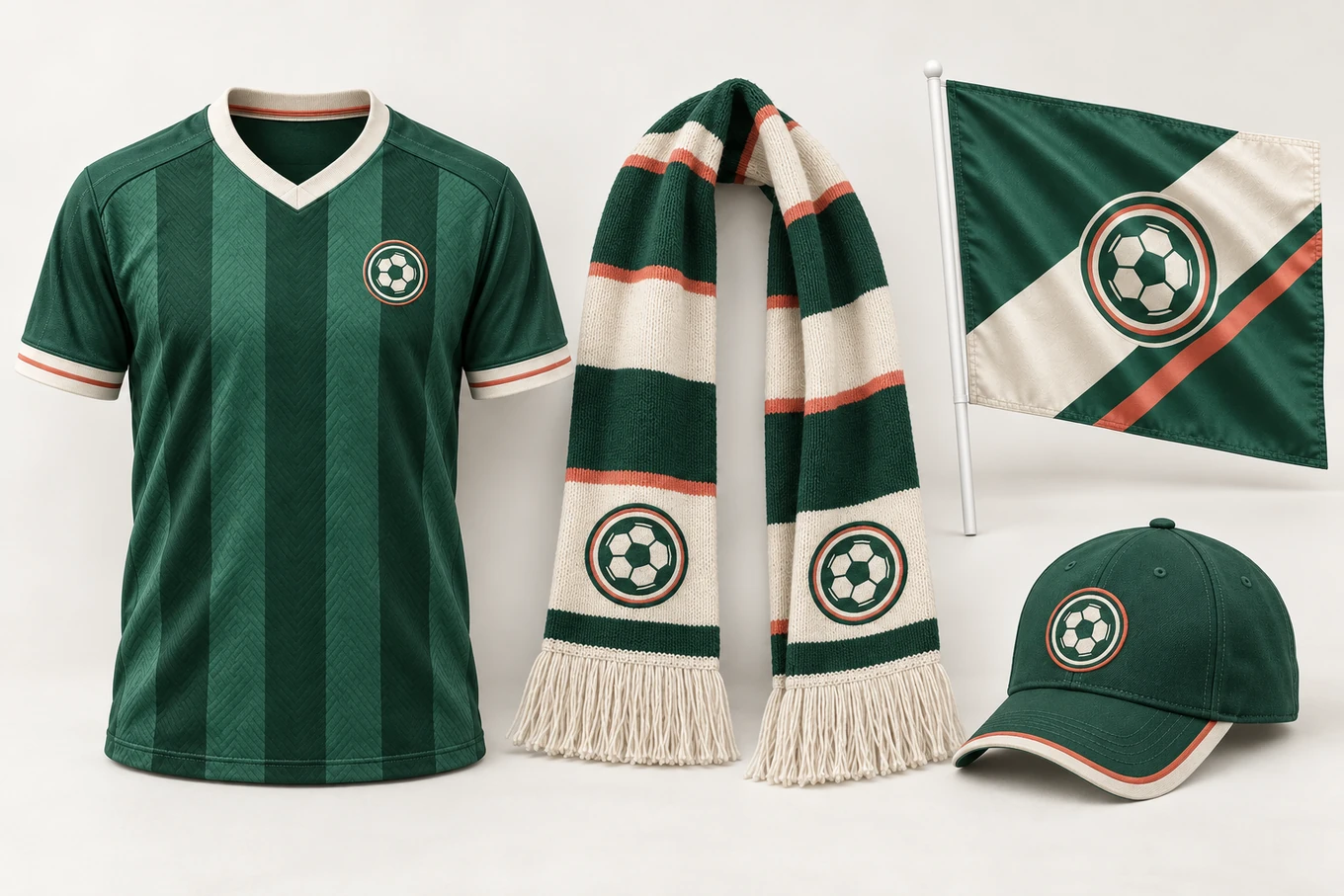
Handheld flag + scarf + badge
Confirm the match date, distribution method, pack size and required receiving date.
Cap + keychain + member card and packaging
Confirm membership batches, gift-set assembly and delivery dates. Collect quantities by size before adding clothing.
Commemorative T-shirt + scarf + badge
Approve the anniversary artwork, colour references, design versions and launch date.
A combined order total does not set the MOQ for every item. We review quantities, samples, packaging and schedules by product before coordinating the range.
Choose what leads the collection, what supports it and what should wait for a later release.
Colors, logos, character features and legal marks need controlled references across processes.
Each product may have different setup, sample, MOQ and production readiness dates.
All SKUs, inserts, labels, sets and cartons must reach one packing and delivery plan.
The collection needs one visual system, but plush, acrylic, pins, print and packaging do not share the same sample or production schedule.
Choose which SKU carries the main character experience, which products offer lower price points and which items can wait. This prevents an oversized first range from delaying the entire launch.
Every SKU keeps its own artwork, sample and packing status. A separate collection row controls shared colors, naming, legal marks, launch priority and the buyer-side approval owner.
When one product needs longer development, the buyer can hold the full set or approve a phased release. The decision should be visible before consolidated packing or event delivery becomes a promise.
Tell us the artwork, intended use, quantity by design, packaging and receiving date. We will confirm the workable format, sample route and quotation basis.
You do not need a finished technical pack. Send what is available and mark unknown items clearly.
We review the artwork, use, size and quantity before planning the sample. Once the sample is approved, the written specification guides production, QC, packing and delivery.
Discuss this productNo. A phased launch can reduce risk when one product has a longer sample or tooling route.
They can be coordinated, but fabric, plastic, acrylic, metal and print reflect color differently and need material-specific approval.
We maintain product-level specifications plus a collection-level matrix for artwork versions, colors, approvals, packaging, readiness and delivery.
Send the artwork, expected quantity, target market and timing. We will review the size, materials and packaging, then confirm what is needed for a quotation or sample.