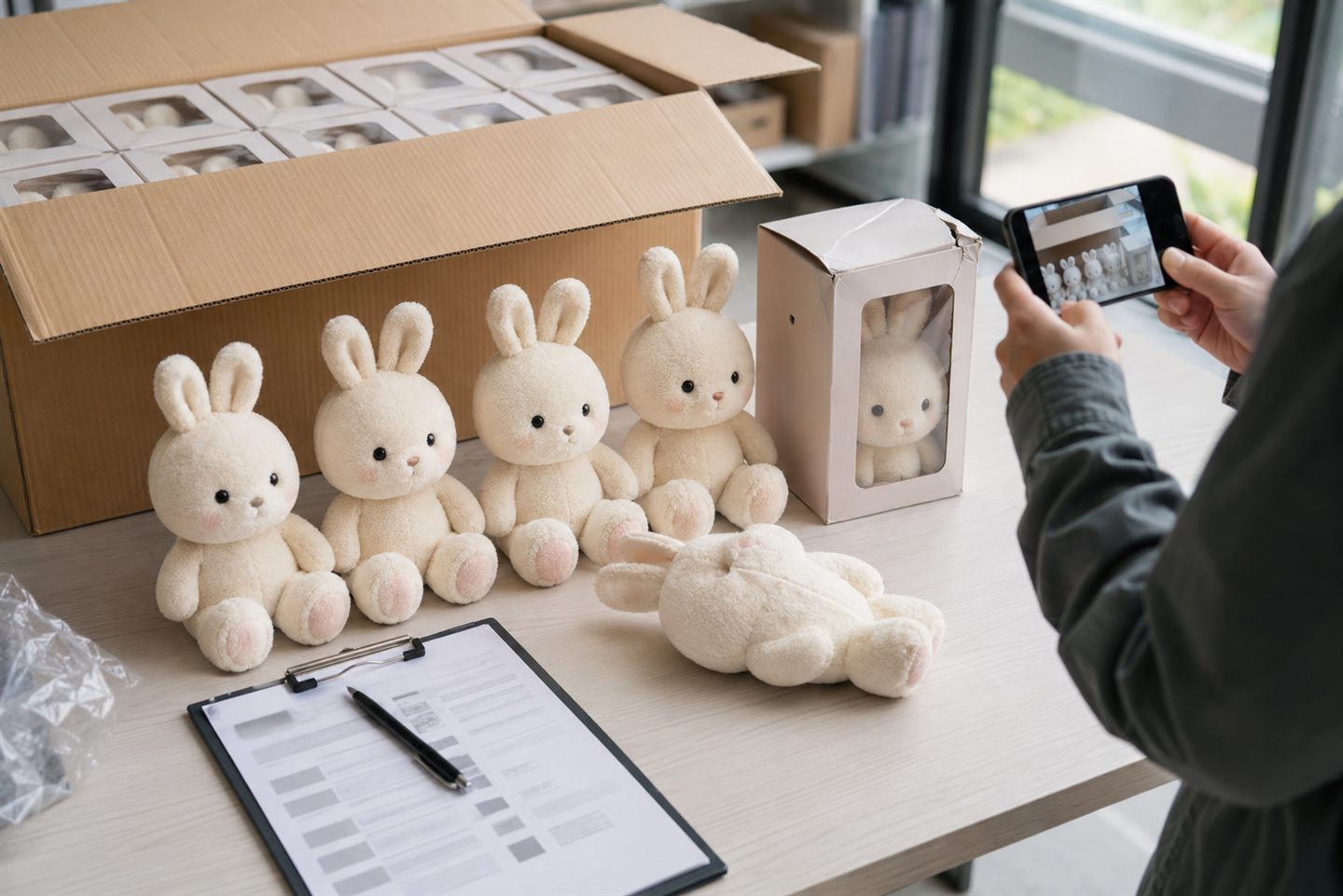
From a Plush Concept to Customer Delivery: 12 Key Stages I Learned in OEM Projects
I began by comparing the price of the plush body. After following complete projects, I learned that the customer receives a product created by design, materials, labels, hardware, packaging, inspection and logistics together.

When I first started working on plush toy OEM projects, I focused on the same thing most buyers focus on first: price.
How much would one factory quote for the same product? Why was another factory slightly more expensive? If I went directly to a factory, would I always get the lowest cost?
If we compare only the sewn plush body, factories usually do have a price advantage. They have pattern makers, equipment and experienced sewing teams. What they do best is turn an already-defined product into a physical item.
After following several projects from inquiry to delivery, however, I gradually understood that the customer never receives only a sewn plush toy.
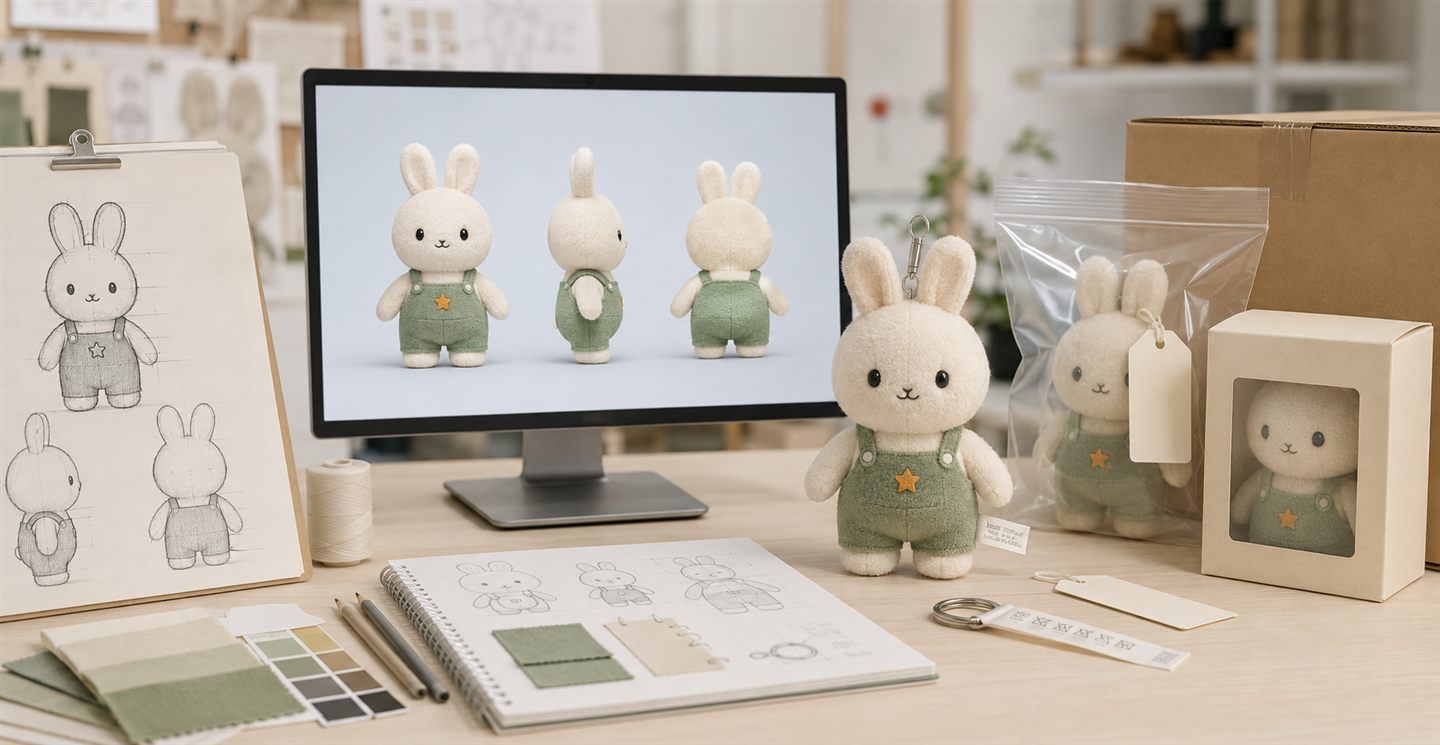
A product that can actually be sold and delivered may also need fabric approval, a care label, hang tag, anti-counterfeit label, key ring, connecting webbing, OPP bag, retail box, inner tray, export carton, packing rules, inspection and international shipping. If one part is not confirmed, a small saving in unit price can disappear through rework, replacement goods or a missed delivery date.
I did not understand all of this at the beginning. I learned many of the details below by purchasing, reviewing samples, checking proofs, inspecting bulk goods and helping resolve problems after delivery.
I am sharing them not to prove that one party is more professional than another, but to help first-time plush OEM buyers avoid some of the detours I took.
Quotation — a low plush-body price does not mean a low total project cost
I used to look first at the price for “one plush toy.” I later learned that unit prices cannot be compared when different suppliers include different things.
One quote may cover only the plush body. Another may include a standard care label and OPP bag. A third may include a key ring but exclude the hang tag. Packaging, carton packing, accessory assembly and domestic transport are sometimes calculated only after bulk production is nearly finished.
The useful questions are not limited to “How much is one toy?” They include:
- Which fabric and filling are included?
- Are the care label, woven brand label and hang tag included?
- What style, size and finish of key ring is included?
- Does the price include an OPP bag, retail box and export carton?
- Who assembles the hang tag, hardware and packaging onto the product?
- How are sample fees, revision fees, inspection fees and shipping calculated?
A low initial quote is not necessarily cheaper if the buyer must separately coordinate a printer, hardware supplier, packaging factory and freight company. The more suppliers involved, the easier it is for file versions, schedules and responsibility boundaries to become confused.
Today I compare the cost of the product in the condition in which the customer can actually sell and deliver it: plush body, accessories, packaging, carton packing and transport included.
Artwork — an attractive picture is not automatically a production file
Many customers first contact me with only a front view of a character. Sometimes they have a reference photo or a hand-drawn sketch.
The character is complete in the customer's mind, but the factory may see only the front. The head depth, back view, limb connections, tail position, standing or sitting pose and clothing layers are still undefined.
If sampling starts immediately, the pattern maker must fill in those missing decisions. The interpretation may be reasonable but still different from what the customer imagined. When the sample arrives, the customer says it feels wrong while the factory believes it followed the picture. Neither side intended a mistake; they simply did not share a sufficiently clear visual reference.
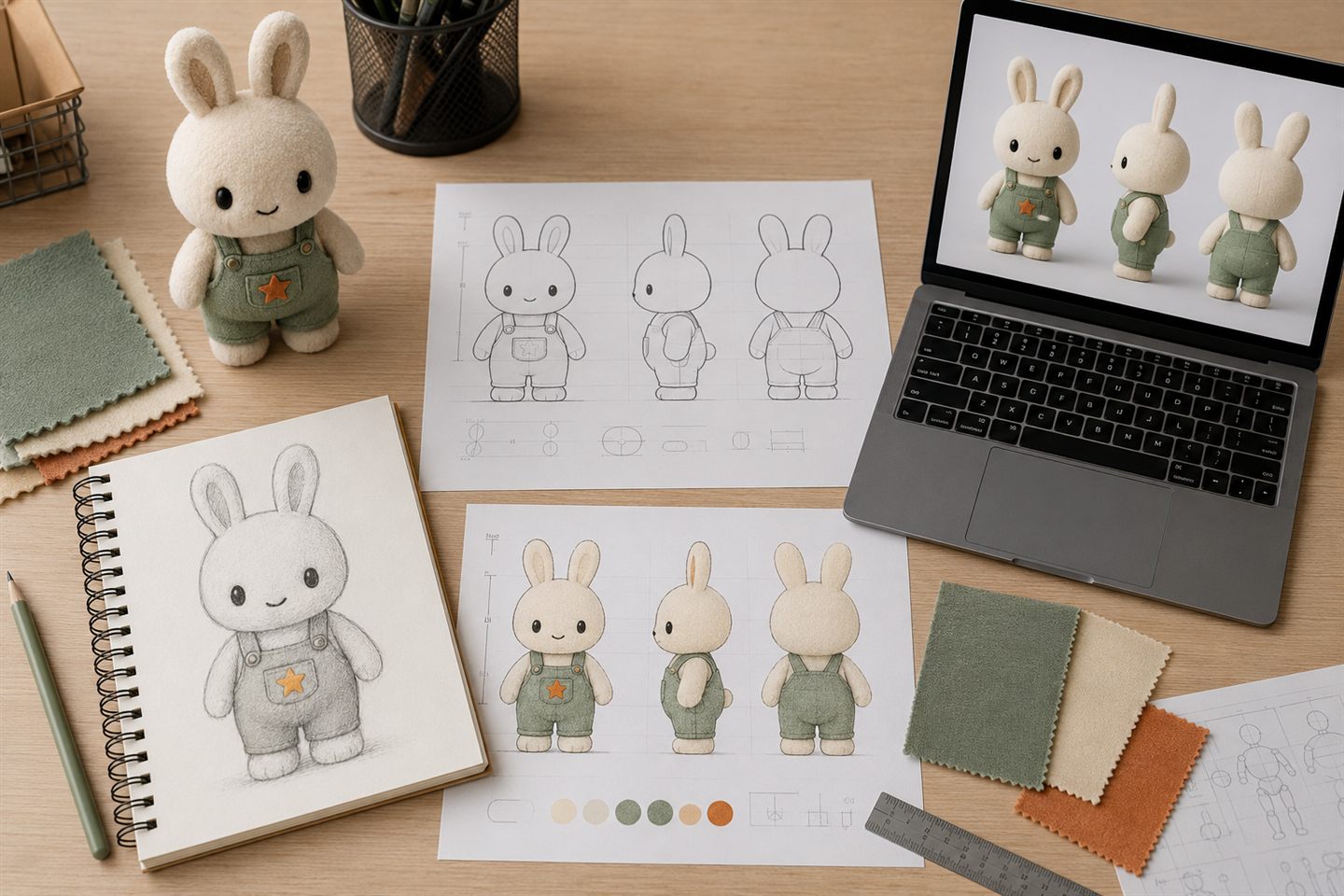
That is why I now put more emphasis on renderings, orthographic views and multi-angle confirmation before sampling. I ask our design team to organize the front, side and back views and confirm proportions, facial-feature positions, clothing construction, color areas, embroidery positions and the location of the key-ring attachment.
This step cannot replace a physical sample. Its purpose is to let the customer, designer, merchandiser and pattern maker see the same proposed product before materials are cut. Details that are too small or too complicated for stable production can be discussed early. Our custom plush development page explains the artwork and structure information that is useful at this stage.

The greatest value of a rendering is not making the product look beautiful. It is reducing the number of people who must complete the same design with their own imagination.
Sampling — the first sample is not the answer; it is where open questions become visible
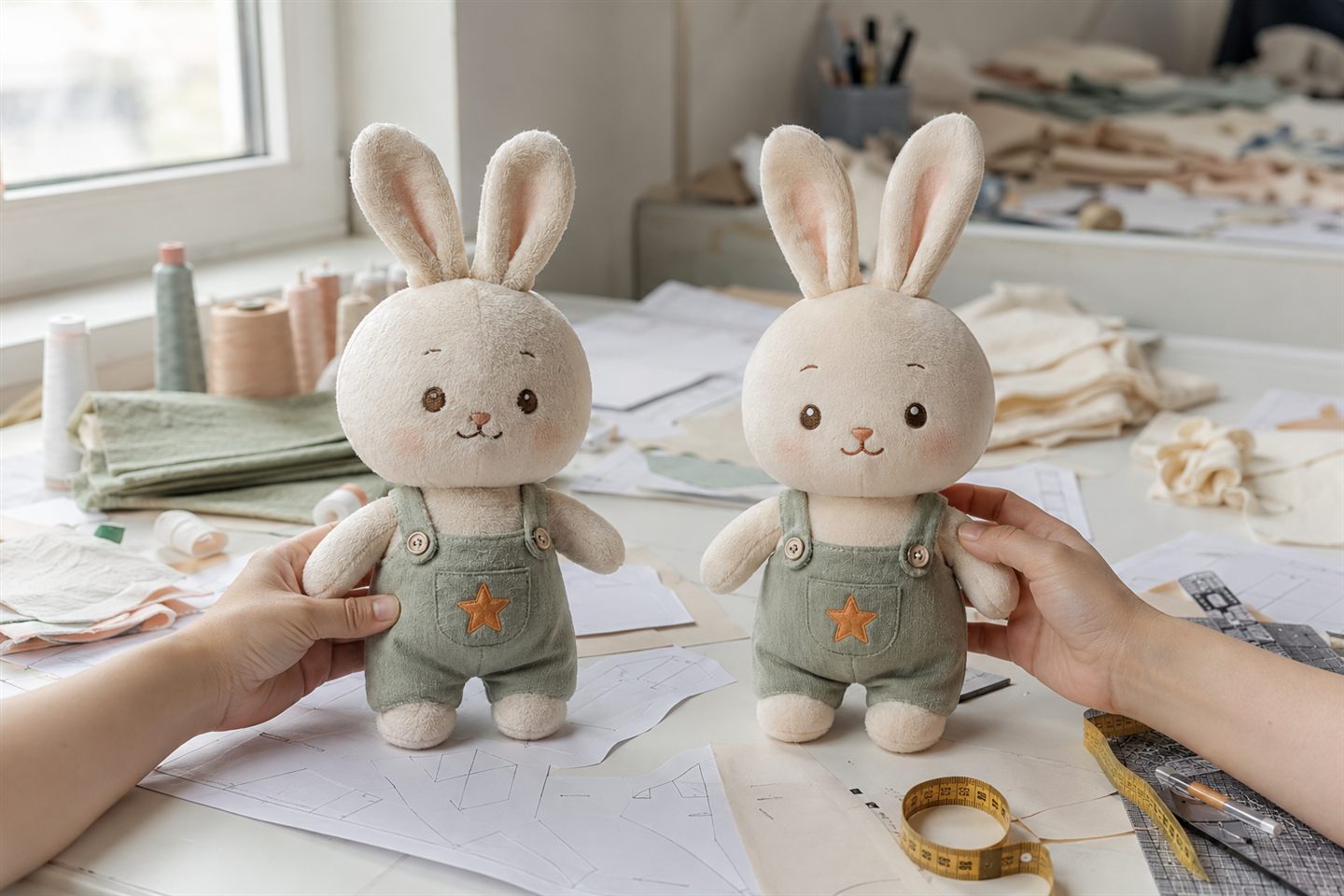
I once assumed that producing the first sample meant the project was almost finished. In practice, the first sample is where a flat drawing meets fabric, embroidery, filling and gravity for the first time.
A face that looks balanced on screen may look crowded after embroidery. A head-to-body ratio that seems right in a drawing may become top-heavy after filling. An accessory that appears light may pull the product to one side when it is attached.
Some rushed samples also use a similar fabric, thread color or hardware part temporarily. Unless this is stated clearly, a buyer may assume every sample material will be used in bulk production.

When I review a sample now, I separate the comments into several groups:
- overall shape and head-to-body proportions;
- facial features, expression and embroidery position;
- fabric, color and pile direction;
- filling level and hand feel;
- clothing, tail and separate accessories;
- care-label, hang-tag and key-ring positions;
- the final condition after individual packaging.
Comments should not arrive as one message today and another tomorrow. Scattered comments are easily missed. I prefer one annotated image set or one consolidated list that identifies required changes separately from optional improvements.
After approval, dimensions, fabric, embroidery files, hardware and packaging method must be recorded together. Saying “make bulk goods like the approved sample” is not enough if there is no written standard to check during production.
Fabric — a similar color does not create the same product feeling
Fabric is something I am increasingly reluctant to approve from photographs alone.
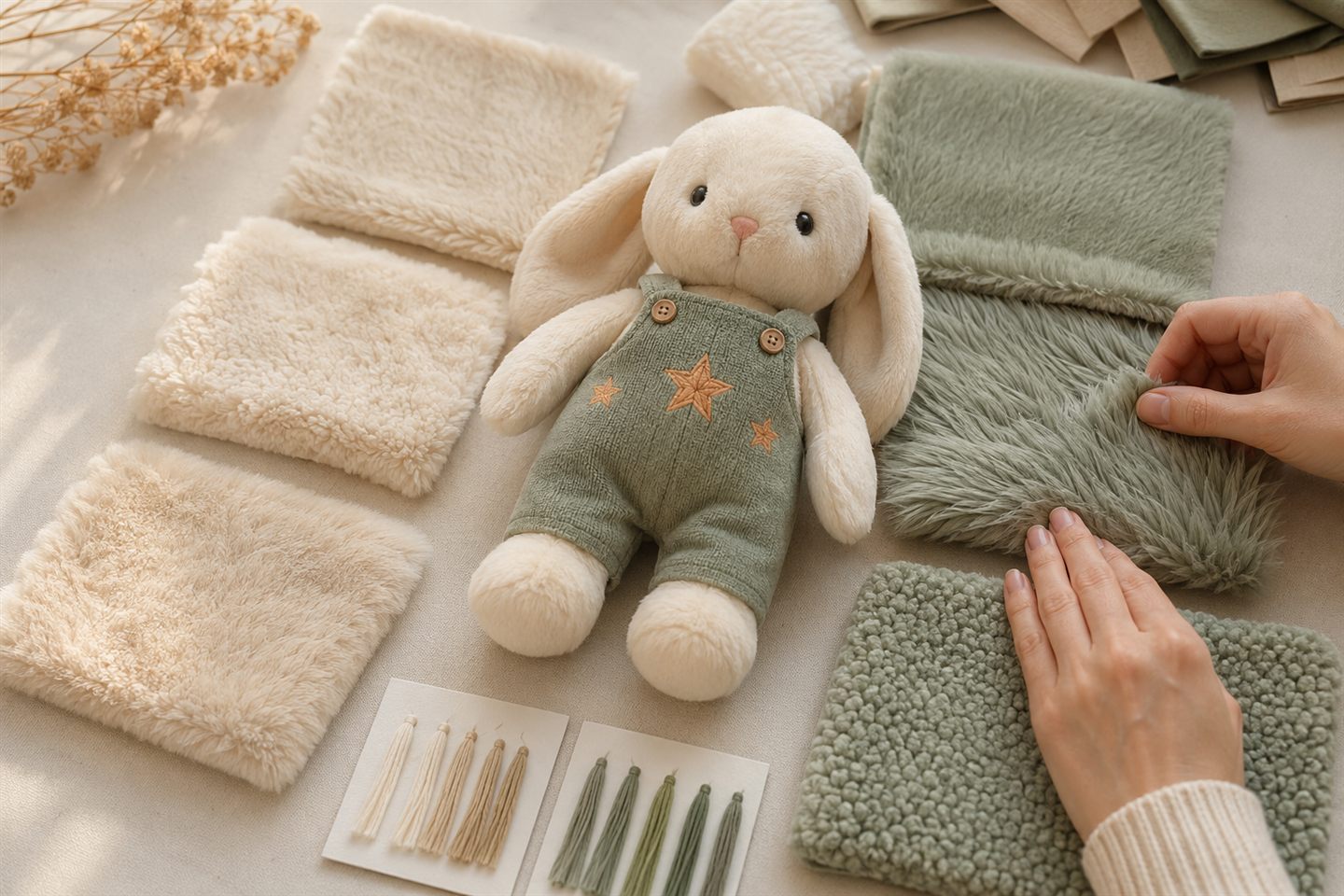
Short pile, long pile, minky, faux rabbit fur and sherpa can produce completely different outlines even when all are described as white or cream. Pile length, density, stretch and direction affect whether a character looks precise and rounded or loose and bulky.
This is especially important around the face. Long pile can cover small embroidery. Different pile directions can make two panels appear to be different colors. A highly elastic fabric can change the filled dimensions.

The phrase “the color is close” often creates misunderstanding. A close color on a monitor, in a phone photo or under warehouse lighting may not look close when the customer receives the physical product.
When color and touch are important, I try to confirm a physical swatch. I also ask whether the sample fabric is the intended bulk fabric, whether stock is available, whether custom dyeing is required and whether shade variation may occur between batches. Once bulk fabric has been cut, changing it becomes a very different cost decision.
Care label — a label only a few centimeters wide can affect the whole batch
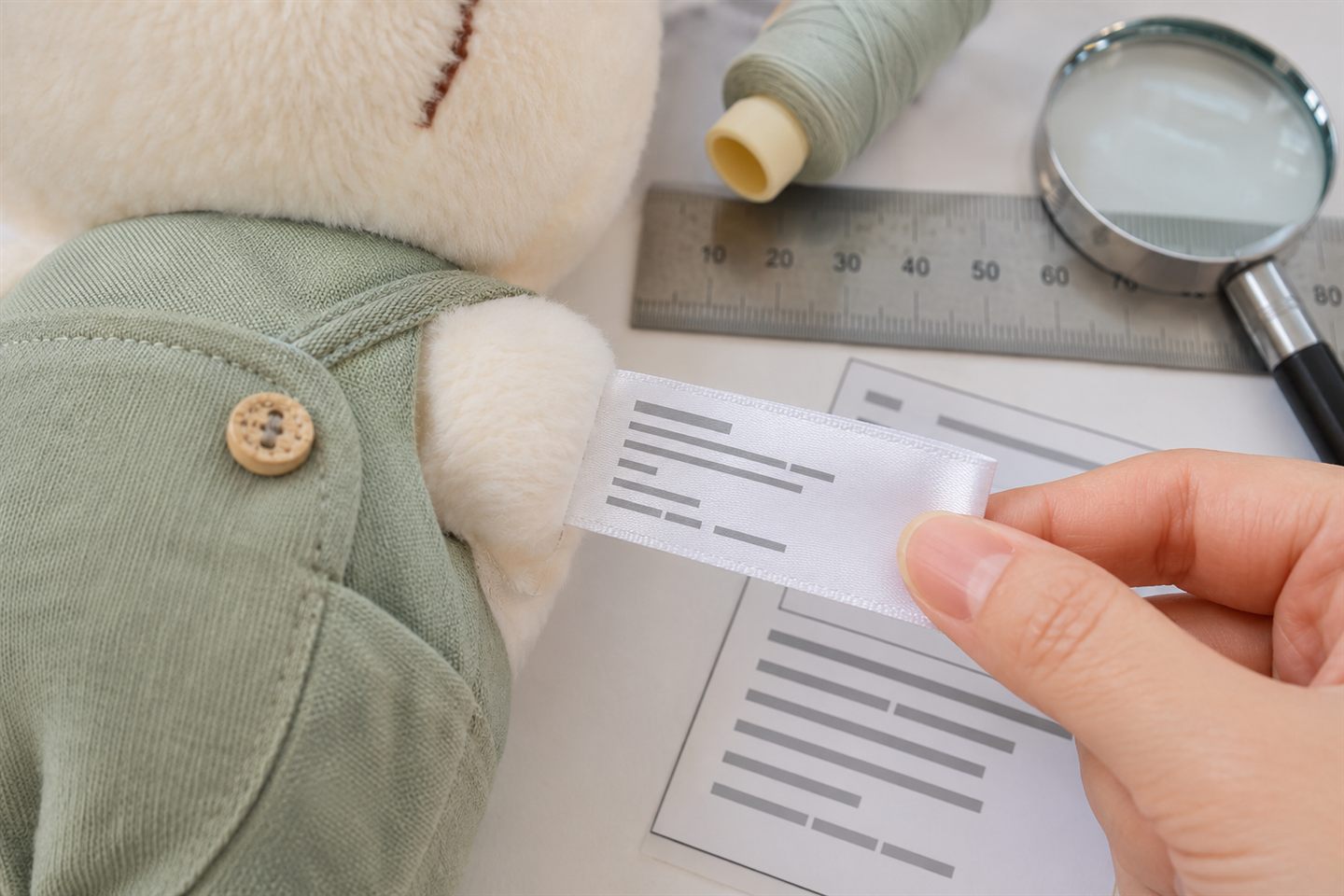
A care label looks small enough to be treated as a last-minute piece of fabric. In reality, the brand name, material information, country of origin, care instructions, warnings, language, type size, finished dimensions, fold and sewing position all require confirmation.

A care label is not the same as a hang tag. It is sewn into the product and becomes part of the product itself. If a text, direction or version error is found only after all labels have been sewn, correction may require opening seams across the entire batch.
My care-label check now includes:
- whether the file is the customer's final approved version;
- whether the front, back and fold directions are correct;
- whether important text will be hidden by the seam;
- whether the label belongs on the left, right or bottom;
- whether styles or language versions could be mixed;
- whether the bulk label is identical to the approved sample label.
The responsible brand, importer or market party must confirm which compliance statements apply in the destination market. Copying another product's label is not a compliance plan. The production team can help control the file, size and sewing position, but should not silently invent the legal content.
Hang tag — it is not a replacement for the care label
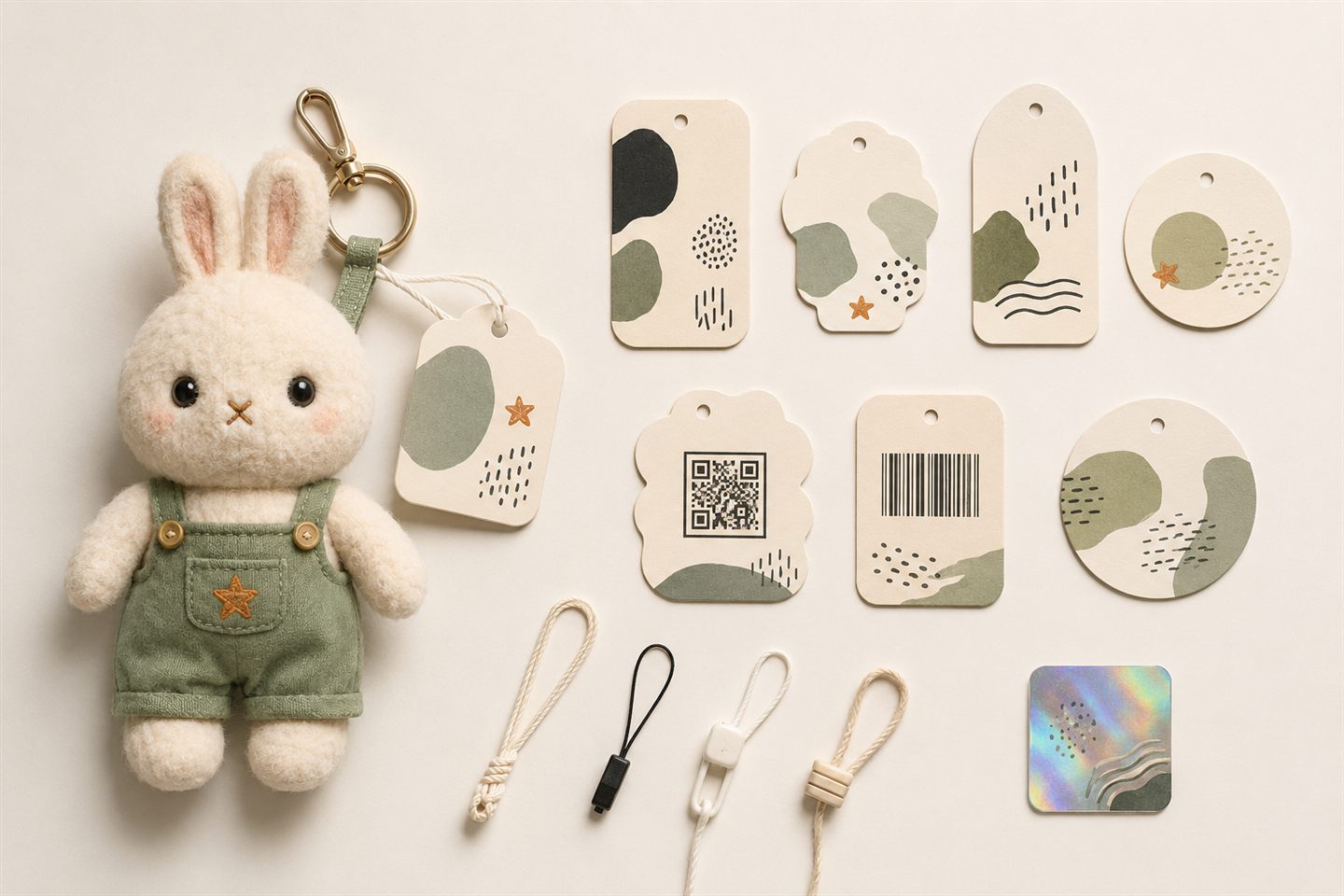
I treat the hang tag as a retail and brand component. It may contain the logo, product name, brand story, barcode, SKU, QR code, campaign information or anti-counterfeit details.

Paper thickness, die-cut shape, coating, foil, hole position and string color all change the result. The tag can also cover the character's face or hang in the wrong direction after assembly.
A correct artwork file does not guarantee a correct printed and assembled tag. I prefer to approve the print proof and a physical tag attached to the real sample. Barcodes, QR codes and anti-counterfeit elements should be tested, not accepted simply because a code is visible.
When several styles are produced together, the packing instructions must prevent product A from receiving product B's hang tag. Looking only at the plush body will never reveal that error; product, tag, barcode and carton rules must be checked together.
Key-ring hardware — being able to hang the product does not mean the right part was selected
When I first sourced plush keychains, I treated the key ring as an ordinary accessory and assumed the factory's standard option would be enough.
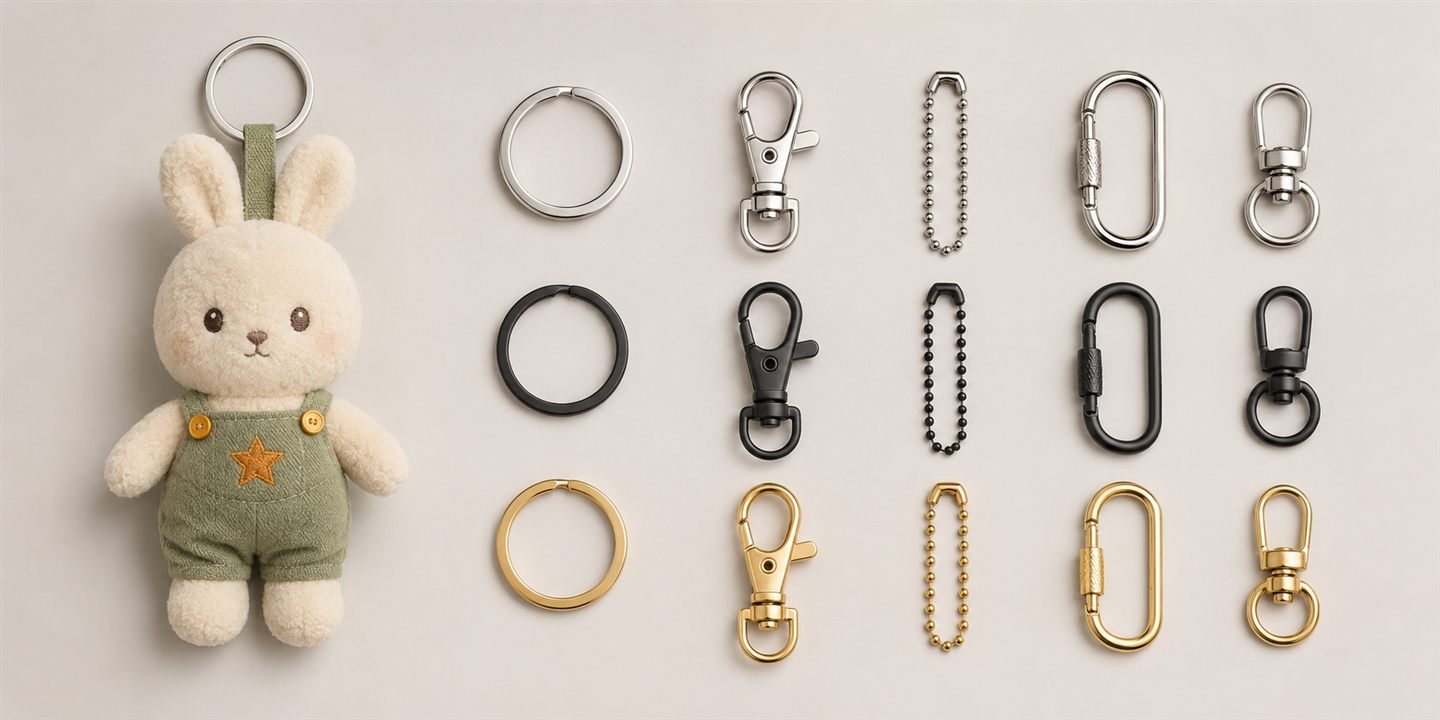
I later learned that a split ring, lobster clasp, ball chain, D-ring and swivel hook provide different use experiences. Silver, gold, black and special plating also create different brand impressions. Hardware that is too large dominates a small plush; hardware that is too small may be difficult to use or unsuitable for the intended load.

The attachment point is just as important. A plush that looks correct lying flat may twist sideways when hanging. If the webbing is placed incorrectly, the character may never face forward. If the connection is not reinforced, it may loosen during use.
There is nothing wrong with a factory using stable, familiar parts from long-term suppliers. But when the customer has a specific style, finish or brand requirement, choosing only from the factory's usual options can unnecessarily narrow the project.
I now confirm the hardware style, size, finish, attachment position, reinforcement and hanging direction during sampling instead of adding a convenient clasp after the plush body is finished.
Packaging — it is not a bag added after bulk production
Packaging is one of the most underestimated parts of a plush project and one of the easiest places for cost to change.
Buyers often focus on the plush body until bulk production is nearly finished and only then ask what bag to use, how large the box should be and how many units should go into one carton. By that point, product dimensions and the delivery schedule may already limit the available choices.

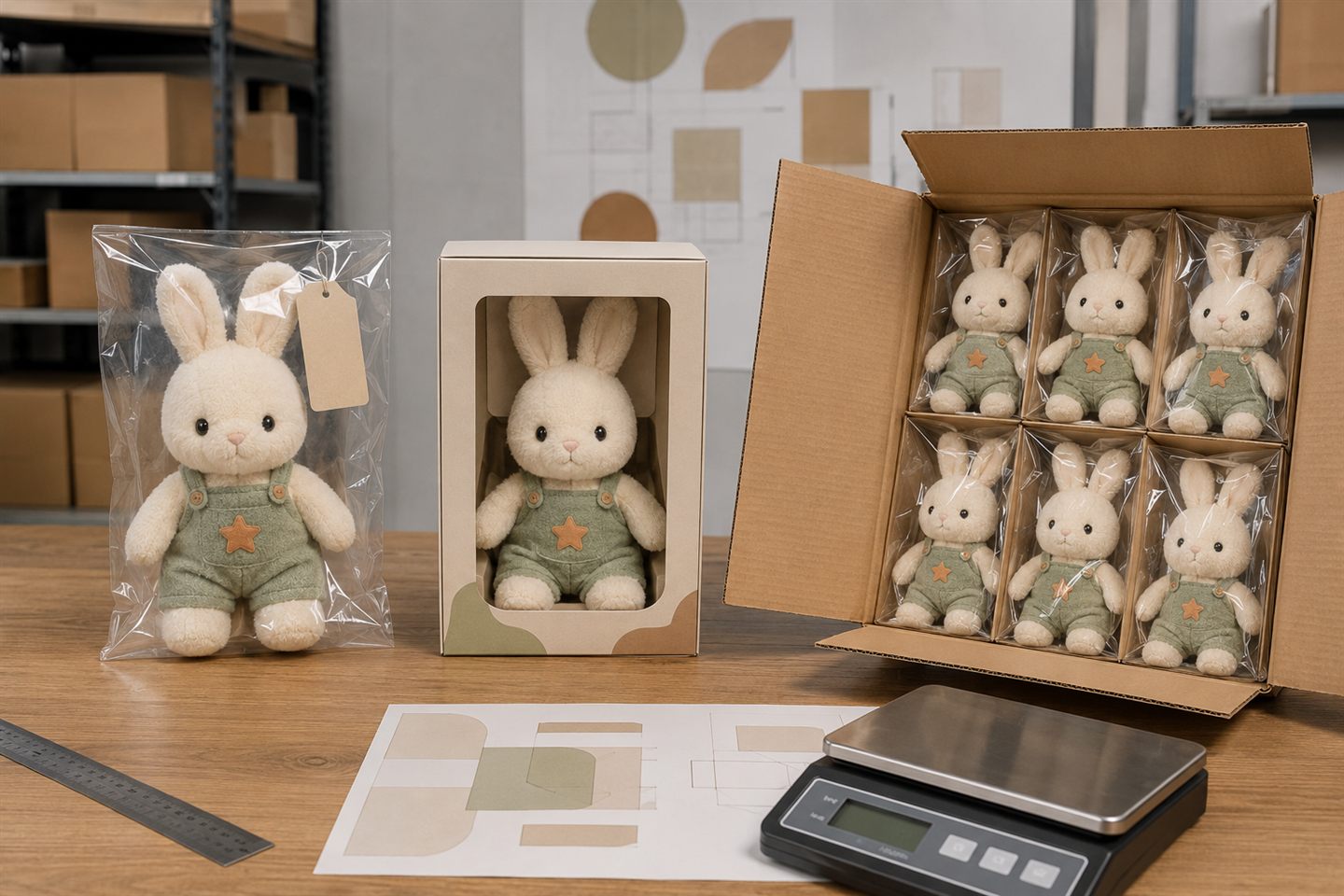
An OPP bag that is too tight can keep a plush compressed. An oversized bag allows the product, hang tag and hardware to move and look untidy. If a retail box is required, the die line, window, insert, board, printing, assembly and transport strength must be checked with a real product. A digital mock-up alone cannot prove that the product fits.
Packaging also changes freight cost. Plush products are usually light but bulky, so international transport is often charged by volumetric weight. A few extra centimeters per retail box can become a significant difference across a full order.
Carton packing cannot simply mean fitting in as many units as possible. Excessive compression may prevent the product from recovering after delivery; loose packing wastes space. Units per carton, carton dimensions, gross and net weight, carton marks, mixed-SKU rules and spare quantity should all be confirmed before shipment. I now prefer to consider packaging during sampling because the customer buys the packed product, not the bare plush body.
Bulk production — an attractive approval sample does not reproduce itself
After sample approval, it is easy to believe the hardest part is finished and the factory only needs to copy it. But one sample becomes hundreds or thousands of units. Pattern cutting, embroidery, sewing, filling, hardware, labels and packing must be repeated by more people over more time.
Before bulk production, I reconfirm the fabric, thread colors, embroidery files, pattern version, hardware, care label, hang tag and packaging. If a material or process needs to change during production, the change must be disclosed and approved before it spreads across the batch.
The greatest bulk-production risk is not one person making one mistake. It is the same mistake being repeated hundreds of times. That is why the first units off the line should be compared with the approval sample while adjustment is still possible.
Quality control — a few selected photographs do not represent the batch
I used to feel reassured when a factory sent several attractive finished-product photos. I later understood that these photos prove only that the photographed units look acceptable. They do not prove the total quantity, dimensions, labels, accessories, packing and cartons are correct.

Plush is a soft, partly handmade product, so not every unit can be identical like a machined part. Reasonable handmade variation must still be separated from defects and specification errors.
My pre-shipment inspection check normally covers:
- overall outline, head-to-body proportion and expression;
- the stability of facial features, embroidery and clothing positions;
- open seams, holes, stains and uneven filling;
- care-label content, direction and sewing position;
- the security of key rings, attachment points and webbing;
- the match between hang tags, barcodes, SKUs and anti-counterfeit details;
- individual packing, units per carton and carton marks.
Depending on the order quantity, risk and budget, the project may need sampling inspection, expanded inspection, full inspection or an independent third-party inspection. QC is not about trying to catch the factory doing something wrong. It is about finding solvable problems while the goods are still in the place where they are easiest to solve.
Delivery and logistics — dispatch does not mean the project is finished
Everyone relaxes when the goods are finished, but delivery still contains several points of risk.
Actual carton count, units per carton, dimensions, gross weight, volumetric weight, invoice, packing list and carton marks must agree. Courier, air and sea routes have different prices and timelines. The quote must also state whether customs clearance, duties and final-mile delivery are included.
When a customer has a fixed launch, match, event or holiday date, we cannot rely only on a carrier's estimated transit time. Production, inspection, booking, export handling, customs and final delivery all need schedule buffer.
Before dispatch, I keep photos or video of the batch, individual packaging, cartons, carton marks, weight and handover condition. These records are not collected to avoid responsibility. They help identify what happened if a problem is found after arrival. Our shipping guide explains the information needed to compare delivery routes.
After receipt — signing for the cartons is not the end of responsibility
I increasingly judge a project not only by whether everyone is happy on dispatch day, but by whether someone continues to take responsibility after the customer receives the goods.
Long-distance transport can compress plush, dent retail boxes or move accessories. Some issues become visible only when the customer opens, counts and prepares the products for sale.

When a problem occurs, the first step I learned is not to argue about responsibility but to collect the facts:
- Was the export carton damaged, wet or resealed?
- What did the products and packaging look like at opening?
- Which SKU and how many units are involved?
- Does the evidence indicate a product, carton-packing or transport issue?
- Are photos, video, carton marks and batch information available?
Only after the problem is defined can we decide whether the right response is replacement, rework, compensation, spare units or a change to packaging and QC for the next order.
I do not believe any supplier can promise that custom projects will never have a problem. There are too many linked steps for that promise to be realistic. What matters to me is whether someone follows the issue through and converts the lesson into a check for the next production run.
Finally, I want to explain the difference between our role and the factory's role
I am not saying that factories are bad. The opposite is true.
Pattern makers, sewing workers and production teams possess experience that design software cannot replace. Whether a plush can stand, sit steadily, hold a natural filling shape and remain stable in bulk production depends on real factory skill.
If a customer already has complete artwork, dimensions, a BOM, packaging files and its own procurement, QC and logistics teams, working directly with a factory can be efficient and may provide a price advantage.
But many customers who contact me have only one picture or an idea. What they lack is not merely a factory that can sew a plush toy. They need someone to connect design development, visual confirmation, sampling, fabric, care labels, hang tags, hardware, packaging, quality control and shipping.
The factory is best at turning clear requirements into a physical product. My work begins earlier: helping the customer turn incomplete requirements into a plan that can be produced, approved and inspected.
I will not promise that every custom project will be perfect on the first attempt. After managing these key stages, I am even less willing to make that promise.
What I can do is clarify problems before sampling, record the standard before bulk production, inspect the product before shipment and remain available to face and resolve issues after the customer receives the goods.
For me, the most satisfying moment is not when the factory finishes sewing the character. It is when the customer receives the product and confirms that it can genuinely be used for the brand, event or sales plan. That is when I consider the project complete.
If you currently have only one picture, start with this information
If you are preparing a plush toy or plush keychain project, collect what you already know:
- character artwork or reference images;
- target size and estimated quantity;
- use case and sales market;
- preferred fabric and key-ring hardware;
- care-label, hang-tag and packaging requirements;
- destination country and required arrival date.
You do not need to make every decision perfectly before contacting us. We can use the available information to list what still needs confirmation before design review and quotation, then move step by step into rendering, sampling and bulk production.
I want the customer to receive more than a quote that looks cheap. I want there to be a responsible route from the first idea to the final delivery.
Direct answers for plush OEM buyers
What should I send for an initial plush OEM quote?
Send character artwork, finished size, pose, quantity per design, critical details, labels or accessories, packaging expectation, destination country and required arrival date. Mark any open decisions instead of guessing.
What determines the MOQ?
Fabric purchasing, pattern and embroidery setup, number of designs, accessories, label versions and packaging all affect the practical MOQ. A total quantity split across many SKUs is not the same as one stable production run.
How long does a plush sample take?
A straightforward sample is often planned around 5–10 working days after the usable brief is confirmed. Complex structures, special materials and revision rounds extend the schedule.
Does an approved sample guarantee identical bulk pieces?
No. Plush is partly handmade. The approved sample and written specifications define acceptable shape, materials and details, while bulk inspection controls variation and defects.
Who approves label and warning content?
The rights holder, importer, seller or other responsible market party should confirm applicable content. AIYYANG can coordinate files, placement, versions and production execution.
When should packaging be confirmed?
Start during sampling and release it before bulk completion. Packaging changes product presentation, compression risk, carton size and freight cost.
Are factory photos enough for final QC?
No. Photos are useful evidence, but the inspection plan should also verify quantity, measurements, defects, labels, hardware, SKU mapping, unit packing and cartons.
How do I start a project with AIYYANG?
Send the artwork and project brief through the inquiry page, WhatsApp or email. Our team will identify missing decisions before giving a sample plan or comparable quotation.
Even if you have only one picture, you can send the project now
Share the character image, target size, estimated quantity, sales market, label and packaging requirements, destination and required arrival date. We will identify the decisions still missing before design review and quotation, then move into rendering, sampling and bulk production.
Related pages